
Match your video length to your marketing goal: under 1 minute for awareness, 1 to 5 minutes to teach, 5 to 30 minutes to convert, and 30-plus minutes to train. Platform limits and the strength of your opening 3 to 10 seconds will refine those ranges. Where budget allows, we recommend planning three cuts, short, mid, and long, from a single production day rather than shooting each one separately.
TL;DR:
- Use 9 to 15 second TikTok ads for discovery, keep organic clips under 60 seconds, and pair longer YouTube videos with Shorts.
- Ads at 30 seconds can improve view through rates and favorability when the brand appears early; measure each against its campaign KPI.
- Owned webinars lasting at least 60 minutes can still reach a 52% play rate, while chapters, timestamps, and targeted forms help retain engaged viewers.
- One shoot can yield three cuts with a 20 to 30 minute interview and cutaway footage every 5 to 7 minutes, framed for vertical viewing.
Table of Contents
- Recommended video lengths by marketing goal
- Platform limits and native preferences for short and long video
- Choosing ad length: 5, 15, and 30-second cuts
- Where long-form video earns its keep
- A studio checklist: planning one shoot for three deliverables
- Optimizing brand video length for mobile viewing
- Testing and measuring your ideal video length with analytics
- How audience demographics shape ideal video length
- What I’ve learned about length the hard way
- How we help you produce the full range of cuts in one day
- FAQ
- Sources
Recommended video lengths by marketing goal
Every brand video has a job, and the job determines the runtime. An awareness clip meant to get a thumb to stop scrolling has no business running past 60 seconds. A training video meant to onboard a new hire has no business being 45 seconds, because nobody retains a software walkthrough at that pace. Matching length to intent is the single biggest lever marketing teams underuse.
For awareness, keep it under 60 seconds. One hook, one idea, one clear visual brand cue, and out. Attention is borrowed, not earned, in that format.
For education, aim for 1 to 5 minutes. Break the content into clear chapters, answer the viewer’s most likely question in the first 30 seconds, and use timestamps if the platform supports them.
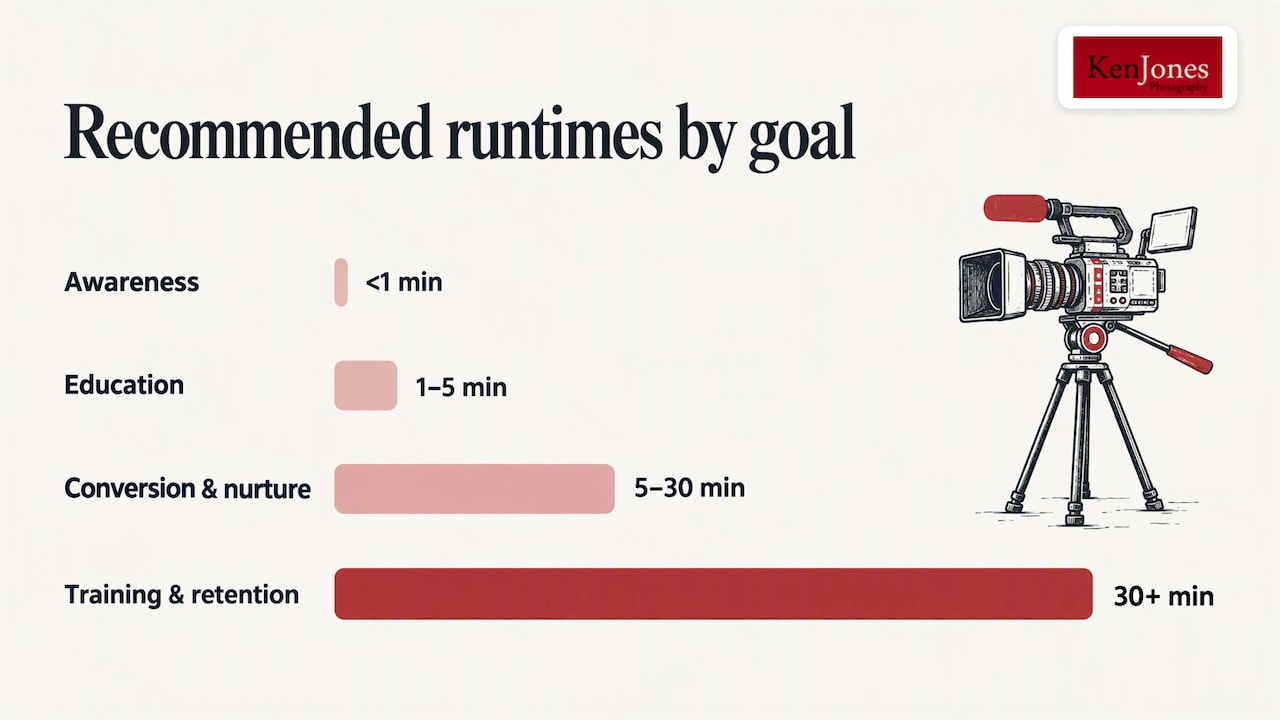
For conversion and nurture, 5 to 30 minutes gives room for a product demo, a case story, and a few well-placed calls to action without losing the viewer.
For training and retention, 30-plus minutes is normal, but it needs to be modularized. Chapters, transcripts, and searchable sections turn a long video into a reference tool instead of a slog.
- Awareness videos under 60 seconds average a 52% engagement rate, which is the strongest payoff-per-second of any format.
- Mid-length videos in the 5 to 30 minute range tend to show higher click-through rates because viewers who stick around that long are already showing intent.
- Training and deep-dive content over 30 minutes works when it is built to be searched, not watched start to finish.
Videos under one minute post a 52% engagement rate, according to Wistia’s research on optimal video length, which means the shortest format rewards you fastest, but it also means you are trading reach for depth. Total watch time still matters for building authority. A 10-minute video that holds a smaller, more engaged audience can deliver more total watch time than several short clips combined, and that aggregate attention is worth something different than a high percentage on a 15-second clip.
Platform limits and native preferences for short and long video
Every platform has its own appetite, and fighting that appetite wastes production budget. We’ve had clients hand us a 90-second hero film and ask why it is underperforming on TikTok, only to find out the opening 8 seconds were a logo animation. Nobody waits for a logo animation anymore.
- For TikTok-style short ad units, 9 to 15 seconds is the sweet spot for discovery and recall.
- For organic Shorts, Reels, and TikTok clips, stay under 60 seconds and front-load the value in the first few seconds regardless of total length.
- On YouTube, longer home content (7 to 12-plus minutes) builds brand depth, but pair it with a Shorts cut for discovery traffic.
- On LinkedIn, 30 seconds to 3 minutes performs best in the feed, while LinkedIn Page posts can run up to 10 minutes for more substantial content.
- Master your file in 9:16 vertical, then derive 16:9 and 4:5 versions rather than reshooting for each aspect ratio.
Specific upload limits and recommended dimensions change often enough that we check a current social video spec sheet before every export pass, because a file that clears Instagram’s compression without a hitch can get flagged or re-encoded awkwardly somewhere else.
Pro Tip: Export your 9:16 master first. Cropping down to 16:9 and 4:5 from a vertical master is far easier than trying to recompose a horizontal shoot into vertical after the fact.
Choosing ad length: 5, 15, and 30-second cuts
Paid creative lives and dies on the first few frames, so the length question here is really a budget-efficiency question. Shorter units stretch media dollars further; longer units ask more of the viewer but can pay back more in favorability.
- Five to 15-second ads are efficient for pure awareness and recall, especially on platforms where skip rates are high.
- Fifteen-second cuts tend to drive strong recall while remaining cost-efficient to run at scale.
- Thirty-second cuts earn room for a narrative arc, and in controlled testing they often lift view-through rate and brand favorability over shorter versions, provided the brand appears early rather than at the very end.
- Longer cuts, a minute or more, work best for mid-funnel storytelling on YouTube or publisher placements where the audience has already shown some interest.
In testing done through Think with Google’s Unskippable Labs, Shorter ads proved efficient for recall, while medium-length cuts showed higher view-through rates and stronger favorability when the story had depth. Fifteen-second ads drive efficient recall, while 30-second cuts can increase favorability when the brand appears early in the story, per that same research. Our rule of thumb: test short for upper-funnel reach and longer for lower-funnel persuasion, and always measure the KPI tied to the goal, recall for awareness, lift for consideration, click-through for conversion, rather than judging every cut by the same number.
Where long-form video earns its keep
Long-form video belongs on assets you own: a resource hub, a gated webinar replay, a product deep dive on your own site. Nobody schedules 45 minutes for a brand they just discovered on Instagram, but they will for a webinar they registered for.
- Place lead capture forms at the point in the video where drop-off data shows engaged viewers, not at the very start.
- Use chapters and timestamps so a viewer can jump to the section relevant to them instead of abandoning the whole piece.
- Repurpose the long version into two or three short clips for discovery, then route that traffic back to the full piece.
Wistia’s webinar recap data shows that videos running 60 minutes or longer can still post around a 52% play rate, and the viewers who finish them tend to convert at higher rates because they arrived with genuine intent. That is the opposite dynamic from social, where length kills reach. On owned platforms, length filters for quality rather than killing it.
A studio checklist: planning one shoot for three deliverables
Here is how we actually schedule a production day when a client needs a hero short, a mid-length explainer, and a long-form interview out of a single session.
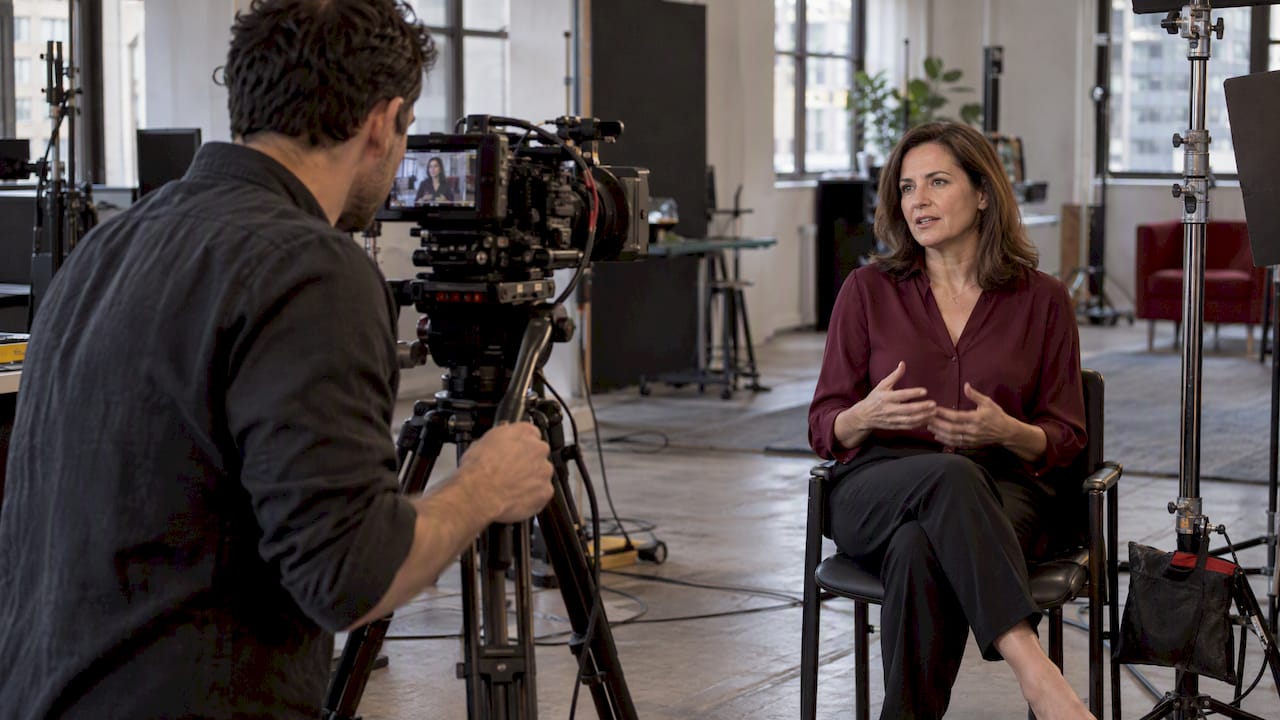
- Block the interview first. Get 20 to 30 minutes of real conversation on camera before anything else, because the best soundbites come out once a subject relaxes.
- Capture deliberate B-roll breaks. Every 5 to 7 minutes, pause and shoot cutaway footage, product shots, hands, environment, anything that gives editors room to cut around a pause or a stumble.
- Flag soundbites on set. We keep a running log during the shoot noting timecodes where the subject nails a clean, quotable line, because that is the raw material for the 15 to 30-second hero cut.
- Shoot vertical-safe from the start. Frame for 9:16 even if the hero deliverable is horizontal, so you are not cropping a head out of frame later.
- Export in this order: hero short first, 60 to 90-second feature cut second, long-form last, since the short cut’s constraints shape what footage you protect in editing.
On file specs, we master in 9:16 H.264 at a bitrate high enough to survive a second compression pass, since every platform re-encodes on upload. Keep safe zones generous, text and logos pulled well inside the frame, since Shorts, Reels, and TikTok overlay their own UI elements differently.
One shoot from a few years back taught us this the hard way: we had a corporate client deliver a 10-minute monologue for an interview video, and the brief called for a tight 90-second social cut. The subject had barely paused, so there was no clean break point anywhere in the footage. We ended up building the short cut almost entirely from voiceover layered over B-roll we shot afterward, on a second visit, at extra cost to the client. Now we plan B-roll breaks into every interview shoot before we roll a single frame of dialogue, specifically so a 90-second story doesn’t require a reshoot.
Pro Tip: Ask your subject the same question twice, phrased slightly differently, early in the interview. You will almost always get a tighter, more quotable answer the second time, and now you have options in the edit.
Optimizing brand video length for mobile viewing
Most of your audience is watching on a phone, often without sound, often while doing something else. That changes what “optimal length” means in practice. A video that reads as well-paced on a monitor can feel slow on a five-inch screen where thumbs are already twitching toward the next post.
Keep captions burned in or embedded as default, since a silent autoplay environment makes your first line of dialogue meaningless without text. Frame close on faces and key details, because small screens lose subtlety in wide shots. Trim pauses that worked in a theatrical edit but read as dead air on mobile, where a half-second of silence can feel like three seconds.
Shorter is generally safer on mobile, but the deciding factor is pacing density, not runtime alone. A tightly cut 90-second mobile edit with a new visual beat every few seconds will outperform a static 45-second clip with long holds. When we cut a vertical version of a brand film, we rarely just crop the horizontal edit, we recut it with more frequent cuts and a faster opening, because what feels like a comfortable pace on a laptop can feel sluggish on a phone screen.
Testing and measuring your ideal video length with analytics
Guessing at length is unnecessary once you have even modest view data. Watch the drop-off curve, not just the average watch time. A steep drop at the 8-second mark tells you the hook failed. A steady decline across the whole runtime tells you the content thinned out somewhere in the middle, and you can usually point to the exact scene.
Run the same creative at two lengths when budget allows, a 15-second and a 30-second cut of the same ad, for instance, and measure the KPI tied to your actual goal rather than judging both by the same metric. Recall matters for an awareness test. Click-through matters for a conversion test. Comparing a recall number against a click-through number tells you nothing useful.
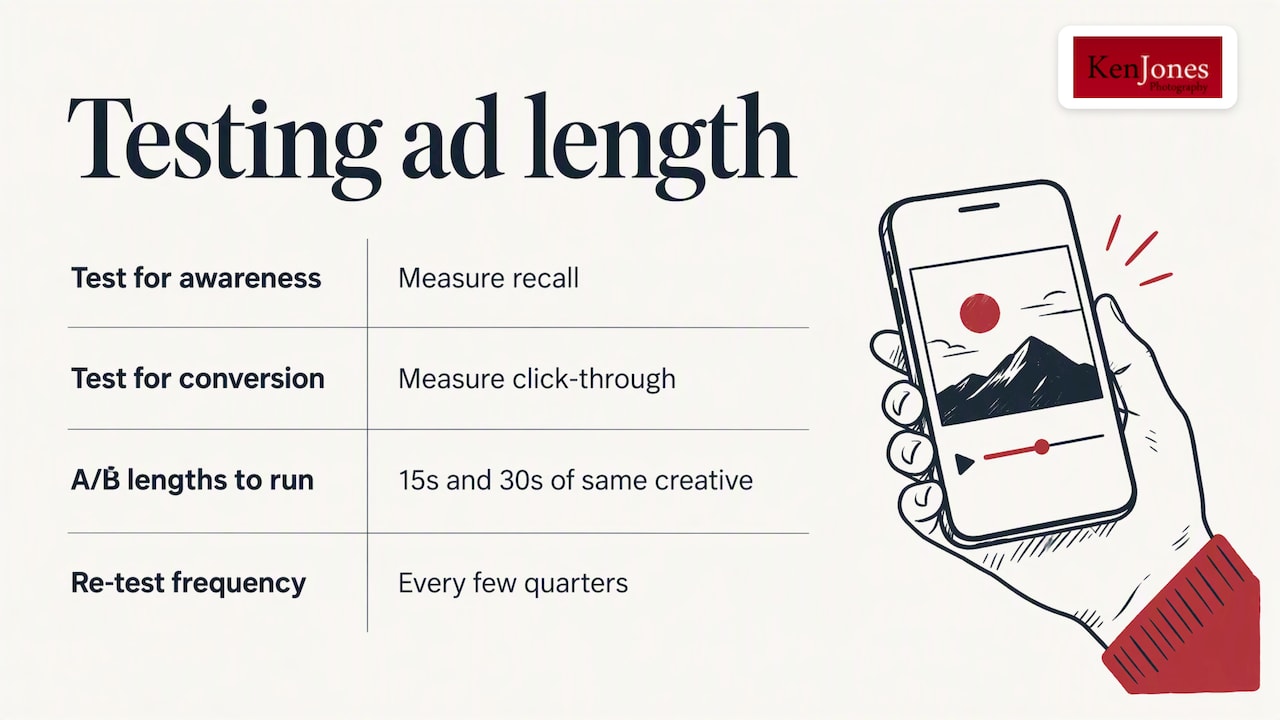
Revisit length assumptions every couple of quarters, because platform behavior shifts and so does audience attention. A format that held attention well last year can start leaking viewers earlier this year for reasons that have nothing to do with your edit, often tied to feed algorithm changes or a shift in what competitors are posting nearby. Treat video length as a hypothesis you keep testing, not a rule you set once and forget.
How audience demographics shape ideal video length
A 22-year-old scrolling TikTok during a commute and a 50-year-old watching a product demo at a desk have different tolerances for runtime, and pretending otherwise wastes production budget. Younger, mobile-first audiences tend to reward brevity and fast pacing, which is part of why sub-60-second formats dominate the platforms they live on.
Professional and B2B audiences watching on LinkedIn or a company site often tolerate, and sometimes prefer, more depth, because they are evaluating a purchase decision rather than killing two minutes between meetings. That is part of why LinkedIn Page content can run up to 10 minutes and still hold an audience that short-form platforms would lose in seconds.
Context matters as much as age. The same executive who skips past a 45-second ad without a second thought will sit through a 20-minute product walkthrough if they are actively shopping for that category. Know whether your audience is in browsing mode or evaluation mode before you lock a runtime, because the same person behaves completely differently depending on which mode they are in.
What I’ve learned about length the hard way
I’ve reshot more short cuts than I’d like to admit because we locked a long-form edit first and tried to carve a hook out of it afterward. It rarely works cleanly. If you can only produce one extra asset from a shoot, make it a short hook and a mid-length explainer built from the same footage, not two unrelated films. Start your next shoot brief with a deliverable plan that sets aside time for three cuts before you ever roll camera.
— Ken
How we help you produce the full range of cuts in one day
We plan video shoots around deliverables, not just a single final file, because most marketing teams need a hero short, a feature cut, and sometimes a long-form piece from the same production day. We handle interview video, product and e-commerce video, and multi-cut brand pieces with consistent lighting and creative direction across every length.

- We can build 3 to 5 different video and photo deliverables in a single production day when the shoot is planned for it.
- Our studio rental includes production support such as lighting, creative direction, and retouching, which helps streamline coordination during shoots.
- We bring the same on-set soundbite and B-roll planning to every shoot, so your short, mid, and long cuts come from one coherent session instead of separate ones.
If you have a shoot coming up and want it planned for multiple deliverables from the start, reach out through our services page to set up a production consultation.
FAQ
What is the 3-3-3 rule for marketing?
There is no single, widely codified “3-3-3 rule” tied to video length specifically. If you encounter the term, it is typically a shorthand some marketers use for structuring content in threes, such as three key points delivered in the first three seconds, rather than an established industry standard.
Can a 10-second video be monetized?
A 10-second video can serve as an effective paid ad unit for awareness and recall, since short formats in the 5 to 15-second range are built for exactly that purpose on most ad platforms. Monetization through ad revenue sharing on platforms typically requires meeting a platform’s own eligibility thresholds, which vary by platform and are set outside any single study.
Is a 4-minute video too long for TikTok?
TikTok supports longer uploads in some cases, but organic performance strongly favors shorter clips, generally under 60 seconds, because the format rewards fast hooks and quick payoffs. A 4-minute video can work as a native upload, but you should expect it to perform more like long-form content than a typical TikTok clip.
Is a 3-minute video too long for LinkedIn?
A 3-minute video sits right at the upper end of what performs well in the LinkedIn feed, where 30 seconds to 3 minutes is the sweet spot for engagement. LinkedIn Page posts can run considerably longer, up to 10 minutes, so a 3-minute video is well within range for a company page post.
What video length works best for a product demo?
Product demos generally fall into the 5 to 30-minute conversion and nurture range, since viewers watching a demo have already shown intent and want enough depth to make a decision. Shorter teaser cuts of the same demo, under 60 seconds, work well for driving traffic toward the full version.
Sources
- How to Choose the Right Marketing Video Length for Any Goal | Wistia
- Unskippable Labs: How ad length affects brand metrics | Think with Google
- Playcut social-video spec sheet