Antelope Canyon was one of those places I had always wanted to see and photograph. When I was hired for a shoot in Las Vegas, I decided to extend the trip and book a photography tour of the canyon while I was already out West.
After finishing the shoot in Vegas, I rented a car that I could leave in Arizona and started the drive with a friend around 6 PM. I thought it would be a simple overnight drive. It became something much stranger, longer, and more surreal.
We drove from Nevada into Utah under a dark sky, with the shapes of mountains barely visible in the distance. For long stretches, there were no other cars on the highway. The landscape felt enormous and empty. At one point, while passing through a secluded area near the mountains, our headlights caught something neither of us could explain, two upright figures standing near the brush before they suddenly ran off into the darkness. I still do not know what we saw, but in the freezing night air, in the middle of nowhere, it did not feel like something easily explained.
After that, my friend fell asleep, and I fought to stay awake through the remaining cliff roads and long desert stretches until we finally reached Arizona as daylight started to break. We checked into a hotel on the reservation for only a few hours of rest before I had to meet the photo group.
Antelope Canyon can only be entered with a Native guide, and for good reason. Slot canyons are beautiful, but they can also become dangerous, especially during rain and flash-flood conditions. Once inside, I quickly realized the tour was more structured toward amateur photographers, with staged setups and instructions on where to stand and what to shoot.
That was never going to work for me.
I naturally broke away from the group, much to the displeasure of the guide, who warned me that I would not get any good pictures if I did not shoot what he told me to shoot.
These are the photographs I made anyway.
The images in this series were created by following the light, the shape of the sandstone, the movement of shadow, and the feeling of being inside the canyon rather than following a preset formula. The canyon itself became the subject: red and orange stone, narrow passageways, ladders leading out of deep crevices, and sunlight cutting through the curves of rock carved by time and water.
This photo essay is less about a perfect postcard view and more about the experience of getting there, surviving the strange overnight drive, and finding my own way of seeing Antelope Canyon.
Antelope Canyon
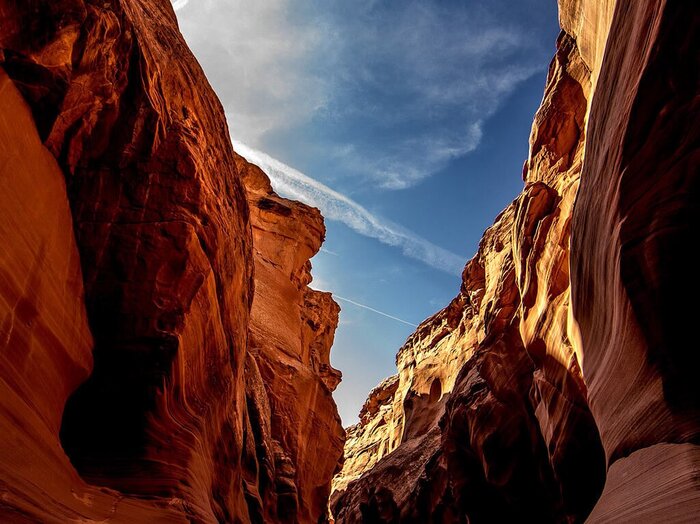
Antelope Canyon interior looking up toward blue sky and clouds framed by red sandstone

Canyon Opening to Sky

Inside Antelope Canyon in Arizona, looking outward toward the open sky. A narrow opening reveals blue sky and drifting clouds framed by the deep red sandstone walls. The contrast between the enclosed space of the canyon and the openness above creates a sense of transition—from interior shadow to daylight.

Light rays entering Antelope Canyon illuminating red sandstone walls

Light Beams Within the Canyon

Standing deep within Antelope Canyon, looking upward as beams of light filter down from above. The sunlight reflects off the red sandstone walls, creating soft, diffused illumination that shapes the curves and textures of the canyon. The scene feels enclosed yet luminous, defined by light rather than direct visibility of the sky.

Antelope Canyon interior with sunlight beams and dust particles in red canyon walls

Interior Canyon Light and Dust

An interior view of Antelope Canyon where light rays pass through the narrow opening above, illuminating suspended dust in the air. The red canyon walls glow with reflected light, creating a layered composition of color, atmosphere, and texture. The image captures the quiet movement of light within the space.

Antelope Canyon narrow opening forming V shape with blue sky visible above

Canyon Opening with Blue Sky (V-Shape)

Looking upward through a narrow, V-shaped opening in Antelope Canyon, where a slice of blue sky cuts through the red sandstone. The geometric shape of the opening contrasts with the organic curves of the canyon walls, creating a balance between structure and natural form.

Light beam in Antelope Canyon with silhouetted guide standing in shadow

Light Beam with Silhouetted Figure

A single beam of light cuts through the canyon, reaching the floor below while a guide stands in shadow in the background. The figure is barely visible, reduced to a subtle silhouette against the illuminated space. The image emphasizes scale, light, and presence, with the human element secondary to the environment.

Red and orange sandstone curves inside Antelope Canyon with sunlight highlighting the carved rock formations.

Sunlight moves across the red and orange sandstone walls of Antelope Canyon, revealing the curves, textures, and carved forms created by time, water, and light.

Ladder leading out of a narrow sandstone crevice inside Antelope Canyon in Arizona, photographed by Ken Jones.

A ladder rises out of a narrow sandstone crevice inside Antelope Canyon, a reminder that the beauty of the slot canyon also comes with danger, depth, and the need for guided access.

Explore more travel and editorial photography by Ken Jones:
Travel Photography | Fashion Photography | Commercial Photography | Contact Ken Jones
Back to Top